|
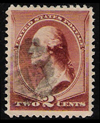
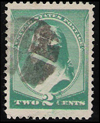
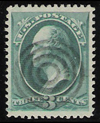
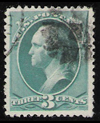
Large Bank Note Period
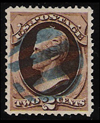
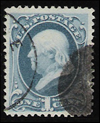
National Banknote Company
| Continental Bank Note Company
| American Bank Note Company
The Large Bank Notes were introduced in 1870 to
replace the 1869 series which was very unpopular with the stamp
buying public. The Large Bank Notes were to remain in use for twenty
years and involve three different printers. The 1870 series was
printed by the National Bank Note Company (NBNC). This series was
issued both with and without grills. In 1873, the Continental Bank
Note Company (CBNC) was awarded the contract to print stamps. CBNC
used the same plates as NBNC and secret marks were added to
distinguish the different printings. It is not known whether NBNC
intentionally added the marks to ensure that their work would be
distinguishable from CBNC work or vice versa. In 1879, the American
Bank Note Company (ABNC) began the printing after they acquired the
CBNC. During the 1880s, ABNC re-engraved most of the stamps in the
series.
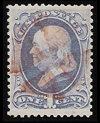
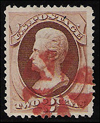
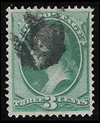
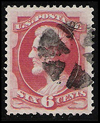
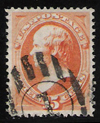
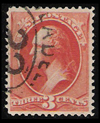
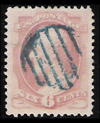
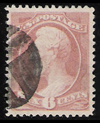
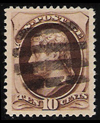
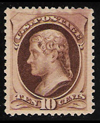
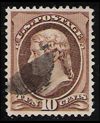
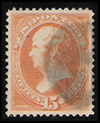
The National Bank Note Company
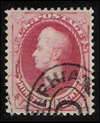
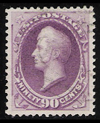
The grilled issue consisted of 11 values (1¢, 2¢, 3¢,
6¢, 7¢, 10¢, 12¢, 15¢, 24¢, 30¢ and 90¢) on white wove paper that was
thin to medium thick. Two different grills, H and I, were used. The
H grill measures 11 to 13 points wide by 14 to 16 points tall,
approximately 10 by 12 millimeters. The H grill is found on all
values in the series. The I grill by contrast is only found on 1
cent through 15 cent values except for the 10 cent value. The I
grill is 10 to 11 points wide by 10 to 13 points tall, approximately
8.5 by 10 millimeters, and it is rarer than the H grill. All values
were also issued without grills. It is not clear exactly what the
sequence of issue was as some values earliest known use is for the
without grill variety.
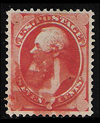
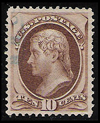
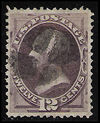
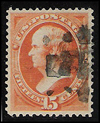
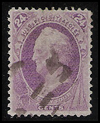
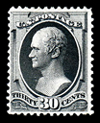
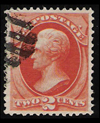
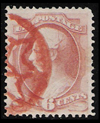
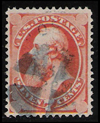
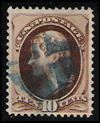
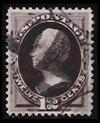
Stamp designs and
colors issued by the National Banknote Company
 Back to top Back to top
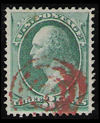
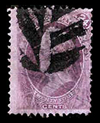
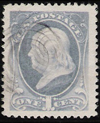
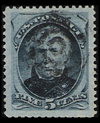
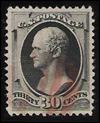
The Continental Bank Note Company
The CBNC initially consisted of the same 11 values
as the NBNC. As previously stated the same plates were used by CBNC
as NBNC. It is thought that all values were secretly marked to allow
the printer to be distinguished. However, secret marks have only
been identified on the values through 15¢ and the 30¢
value. Printings of the 24¢ value by CBNC are known to have been
issued but only one has ever been certified as being a CBNC
printing. That is because it is on ribbed paper and NBNC did not use
ribbed paper. In addition to vertically and horizontally ribbed
paper, straw and silk papers were used. All CBNC issues except for
the 24¢ and 90¢ values can be found with the J grill. It is
suspected that these may be essays and not regularly issue and are
quite scarce. The J grill measures 7 by 9.5 millimeters. In 1875,
the two cent value was printed in a new color and a five cent value
was issued to replace the 6¢ value. CBNC issues are generally on
white wove paper that is thin to thick. The 1875 values are on
yellowish wove paper. In 1875, the CBNC produced special printings
on hard, white wove paper without gum. The initial issue reproduced
the original 11 values, while the second issue reproduced the two
new values. Both special printings were on hard, white wove paper
without gum.
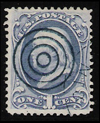
Stamp designs and
colors issued by the Continental Bank Note Company
Back to top
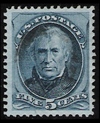
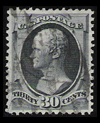
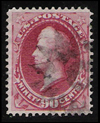
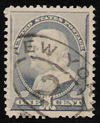
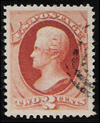
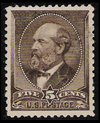
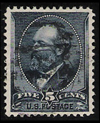
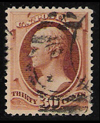
The American Bank Note Company
In 1879, the ABNC acquired the CBNC. The ABNC issued
9 values (1¢, 2¢, 3¢, 5¢, 6¢, 10¢, 15¢, 30¢ and 90¢) on soft porous
paper using the CBNC plates which makes it rather difficult to say
which printings should be attributed to the CBNC and ABNC. The
generally accepted method is to associate those printings on soft
paper to the ABNC. Between 1881 and 1883 and then again between 1887
and 1888 the low values were re-engraved, a four cent value was
introduce, colors were changed and Washington moved to the two cent
value. The color of the two high values was also changed. In 1880,
special printings of 13 values were issued on soft porous paper
without gum. Special printings of the 2¢ re-engraved value and
the new 4¢ value were also produced in 1883 and 1885.
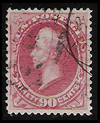
Stamp designs and
colors issued by the American Bank Note Company
Back to top
|