|
News and Highlights
|
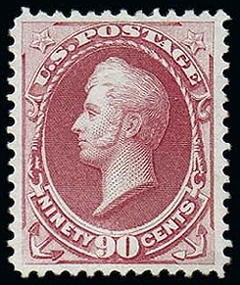
The 90¢ issue printed by the Continental Bank Note Company
in 1873 (Scott No. 166) features the profile of Commodore
Oliver Hazard Perry (1785-1819). An estimated 197,000
stamps were issued. The anchor flukes at the bottom corners
of the stamp design hint of Perry's U.S. Navy career. In the
War of 1812 against Britain, at the age of 27, Perry earned
the title "Hero of Lake Erie" for leading American forces in
a decisive naval victory at the Battle of Lake Erie.
 Read more Read more
|
|
|
USPCS Annual Meeting at
TEXPEX
2011
The USPCS Annual meeting shall take place at TEXPEX from April 15-17, 2011 at the Doubletree Hotel Dallas near the Galleria, 4099 Valley View Ln. (O-635 at Midway Exit), Dallas TX. There is free admission, free parking and show is open to the public. Forms along with hotel rates and information are found on
the
TEXPEX 2011 website.
|
|
Click on the news items
below to read all about the recent activity and achievements by the
USPCS and its members.
View the archive
Welcome to the new USPCS website!
 |
| Wade Saadi, President |
Wade Saadi, USPCS President, the Officers, and
Directors of the USPCS are delighted to introduce our new website. Lorem ipsum dolor sit amet, consetetur sadipscing
elitr, sed diam nonumy eirmod tempor invidunt ut labore et dolore
magna aliquyam erat, sed diam voluptua. At vero eos et accusam et
justo duo dolores et ea rebum. Stet clita kasd gubergren, no sea
takimata sanctus est Lorem ipsum dolor sit amet. Lorem ipsum dolor
sit amet, consetetur sadipscing elitr, sed diam nonumy eirmod tempor
invidunt ut labore et dolore magna aliquyam erat, sed diam voluptua.
At vero eos et accusam et justo duo dolores et ea rebum. Stet clita
kasd gubergren, no sea takimata sanctus est Lorem ipsum dolor sit
amet. Lorem ipsum dolor sit amet, consetetur sadipscing elitr, sed
diam nonumy eirmod tempor invidunt ut labore et dolore magna
aliquyam erat, sed diam voluptua. At vero eos et accusam et justo
duo dolores et ea rebum. Stet clita kasd gubergren, no sea takimata
sanctus est Lorem ipsum dolor sit amet.
Duis autem vel eum iriure dolor in hendrerit in
vulputate velit esse molestie consequat, vel illum dolore eu feugiat
nulla facilisis at vero eros et accumsan et iusto odio dignissim qui
blandit praesent luptatum zzril delenit augue duis dolore te feugait
nulla facilisi. Lorem ipsum dolor sit amet, consectetuer adipiscing
elit, sed diam nonummy nibh euismod tincidunt ut laoreet dolore
magna aliquam erat volutpat.
From The Chronicle
Mistaken 24¢ Rate to Germany, 1857-61
by
Robert S. Boyd
During the period of use of the 1851 and 1857
stamps, letters from the United States to the 39 German States could
be sent by steamer to Le Havre and under agreements with Bremen,
Great Britain, Prussia, Hamburg, and France. The rate structure was
correspondingly complex, with only Bremen and Hamburg having much
commonality. It was incumbent on the sender of a letter to Germany
to select the method based on ships in port at the time the letter
was dispatched. As the decade wore on, the rates became simpler as a
result of increased uniformity of German-Austrian Postal Union (GAPU)
rates among the various states. By 1860, there were two principal
rates to the German States: 30¢ per ½ ounce by Prussian closed mail
and 15¢ per ½ ounce via Bremen or Hamburg. A published option that
was infrequently used was 21¢ per quarter ounce rate by French mail.
 |
|
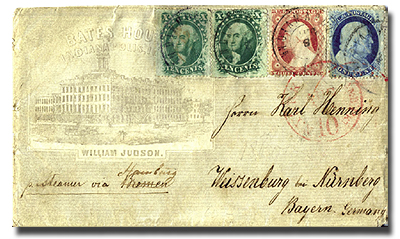
Hotel cover from Indianapolis, 8
August 1860, to Weissenburg bei Nürnberg, Bavaria. Postage
of 24¢ paid by stamps. The left 10¢ stamp represents a reuse
(to defraud the post office) of a stamp from which a
manuscript cancel had been removed. (Philatelic Foundation
Certificate #471,604). |
Apparently there was a widespread misapprehension in
the latter half of the 1850s that a 24¢ rate to Germany existed. In
my collection are seven covers showing payment of exactly 24¢. They
were sent from New York (2), Ohio (2), Michigan, Indiana, and
Louisiana between 1857 and 1861. Another cover paid by two 12¢
stamps in 1857 from Michigan was recently sold in a German auction.
When a U.S. exchange office decided to send one of these letters by
Bremen, Hamburg, or France, 24¢ sufficed to pay the full rate, so
it was merely overpaid. However, such a letter was considered unpaid
in Prussian closed mail, since partial payment of the 30¢ rate was
not permitted. This was an expensive error, as 24¢ in 1860 was worth
about $5 today.
Read more
Back to top
|